
Healthcare organizations are making significant investments in AI, automation, and digital transformation. And many are arriving at the same uncomfortable realization: these investments are only as effective as the operational foundation they are built on.
When AI tools produce outputs that don’t reflect what’s actually happening on the floor, when predictive models generate insights that can’t be acted on in the moment, when digital transformation initiatives stall at the pilot stage without scaling — the cause is almost always the same. The data feeding those systems is fragmented, delayed, or retrospective rather than continuous and real-time.
This is the problem the Real-Time Health System (RTHS) framework is designed to solve. Not as a technology product, but as a strategic operating model that defines what healthcare organizations need to build before advanced capabilities like AI and workflow automation can deliver consistent, measurable results.
What healthcare leaders heard at HIMSS 2026 and ViVE 2026 reinforced this directly: the competitive divide in healthcare is no longer about which organizations have access to AI. It is between organizations that are building real-time infrastructure first and those that are layering intelligence onto fragmented, delayed systems.
See how ViVE 2026 revealed the gap between AI ambition and infrastructure reality →
What Is a Real-Time Health System?
The RTHS is a conceptual and operational framework for the next-generation hospital and health system — one that moves from disjointed, reactive operations toward a coordinated, situationally aware enterprise capable of acting on what is happening right now, not what happened yesterday.
The framework has been developed and advanced by Gartner¹ over several years through its annual Hype Cycle for Real-Time Health System Technologies, most recently published in 2025. It has gained significant traction among healthcare CIOs as a lens for evaluating infrastructure investments and setting digital transformation roadmaps.
The core premise is straightforward: healthcare organizations cannot optimize what they cannot see. And they cannot act on what they can only see after the fact. A Real-Time Health System is one that acquires continuous operational data — where patients, staff, and assets are located and how they are moving — and uses that data to coordinate, automate, and improve care delivery in the moment it is happening.
The Capacity Management Challenge Has Grown More Complex
Capacity management has always been challenging in healthcare due to the dynamic nature of patient movement, specialized staff requirements, and mobile equipment. Unlike manufacturing environments where lean principles operate within more predictable parameters, healthcare settings are fluid and, at times, chaotic.
The stakes have only intensified. Today’s healthcare organizations face:
Workforce Constraints
More than 138,000 nurses left the workforce between 2022 and 2024. The U.S. is projected to face a shortage of more than 500,000 registered nurses by 2030, with 40% of those currently working reporting intent to leave or retire within five years. The ability to optimize existing staff deployment — to do more with the people who remain — has become an operational survival requirement, not a strategic aspiration.
Volume Pressures
Inpatient days are projected to rise 10% by 2035, outpatient volumes are expected to grow 18%, and home-based services by 32%. This redistribution of care across settings demands new approaches to resource coordination and capacity planning that static, periodic reporting cannot support.
Financial and Reimbursement Dynamics
The hospital capacity management solutions market has grown from $5.3 billion in 2025 to a projected $6.2 billion in 2026 — an 18.5% annual growth rate that reflects how urgently healthcare organizations are prioritizing operational efficiency investment. At the same time, shifting reimbursement models, including the continued transition toward value-based care and the margin pressure from Medicare Advantage payer dynamics, mean that operational inefficiency has direct and growing financial consequence.
The Maturity Journey: Four Levels, One Direction
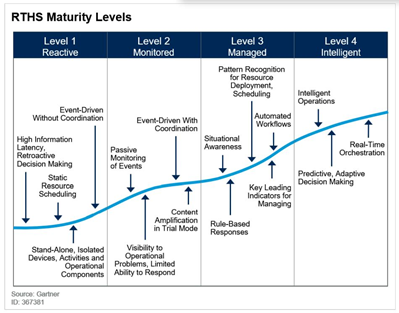
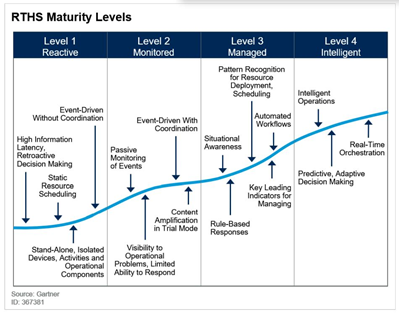
The RTHS maturity model, referenced in Gartner’s research¹, maps the progression healthcare organizations must make to achieve true real-time capacity management capability. While the specific level definitions belong to Gartner’s framework, the operational reality they describe is familiar to any healthcare leader who has tried to act on a dashboard that shows what happened an hour ago.
Most hospitals today operate in the earlier stages of this journey — they have dashboards, they have some visibility, and in some cases they can anticipate what might happen next. What they struggle with is acting in the moment: coordinating resources dynamically as conditions change, automating workflows based on real-time events, and building the feedback loops that allow continuous improvement rather than periodic review.
The gap between where most organizations are and where they need to be is not primarily a technology gap. It is an architectural one. Moving from reactive monitoring to real-time coordination requires a fundamental shift in how operational data flows through the organization — and that shift starts with the data layer itself.
This is the inflection point both HIMSS 2026 and ViVE 2026 confirmed: health systems are investing in AI and advanced analytics, but finding that without the underlying real-time infrastructure, these investments produce insights that are difficult to act on. The data foundation has to come first.
Discover what healthcare leaders learned at HIMSS 2026 →
What Real-Time Infrastructure Actually Requires
A Real-Time Health System isn’t achieved through a single product or vendor solution. It requires a coordinated collection of capabilities that operate across the enterprise:
Continuous Operational Data
Real-time visibility into where patients, staff, and assets are located at any given moment. This is fundamentally different from periodic snapshots or retrospective reporting. It’s the difference between knowing where an infusion pump was two hours ago versus knowing where it is right now.
Cross-System Integration
The ability to surface data from multiple systems and APIs to create unified operational awareness. Patient flow, equipment availability, staff location, and environmental conditions must be accessible across departments, not trapped in isolated systems.
Automated Workflow Execution
The ability to act on real-time data through automated alerts, escalations, and resource coordination. This is the step that moves organizations from visibility to execution — the critical transition that defines operational maturity. A system that surfaces a bottleneck after it has already affected patient throughput is better than nothing. A system that automatically triggers a response before the bottleneck develops is what defines a real-time operation.
Real-Time Location Systems — RTLS — are the enabling layer for all three. RTLS provides the continuous, structured movement data that makes real-time awareness, coordination, and workflow automation possible. Without it, the other layers of the RTHS — analytics, AI, EHR integration — are operating with an incomplete picture of what is actually happening in the care environment.
How AiRISTA Supports the RTHS Journey
Hospitals using AiRISTA’s Sofia™ platform to support patient flow and transport coordination have reported measurable operational outcomes: a 70% efficiency improvement for porters through automated workflows, a reduction in nurse time spent coordinating transport from 40 minutes to 5 minutes per patient transaction, and a 40% reduction in patient transfer turnaround times validated by an independent Ernst & Young study. These results are not driven by analytics alone — they are driven by timely, reliable real-time location events feeding the operational workflows that clinical teams depend on. That distinction matters: Sofia™ is not a standalone analytics or operational intelligence system. It is the location, event, and integration platform that supplies trusted real-time data to the downstream workflows, applications, and hospital systems that act on it.
At its core, Sofia™ continuously tracks the real-time location and status of patients, staff, and assets across clinical environments using Wi-Fi and BLE technologies deployed on existing wireless infrastructure. The platform supports on-premises, private cloud, and SaaS deployment models, allowing health systems to align with their own security and compliance requirements while standing up RTLS capability in days rather than months — without large capital outlays or extensive implementation overhead. Modular licensing allows organizations to adopt Sofia™ for targeted use cases — asset tracking, staff safety, or patient flow — and expand as operational priorities evolve.
Beyond tracking, Sofia™ enables workflow coordination and automation through configurable, rules-based event triggers. Arrivals, departures, dwell time thresholds, and duress alerts can each drive notifications, task creation, and handoffs to connected systems — moving the organization from passive visibility to active operational response. Integration with EHR platforms via HL7 and REST APIs, and with nurse call, staff safety, and building security systems, supports the cross-system coordination that real-time operations require.
The platform is designed to be accessible across a wide range of health system IT maturities. Deployment on existing Wi-Fi infrastructure reduces implementation complexity. The low-code configuration environment means new workflows and use cases can be stood up without intensive engineering overhead, which is what allows organizations to expand their RTLS capabilities incrementally as their operational requirements grow rather than committing to a fixed deployment scope upfront.
Sofia™ supports health systems at every stage of RTLS maturity — from establishing foundational visibility into asset and staff location, to enabling cross-department coordination, to supporting highly automated, event-driven clinical workflows. The starting point varies across organizations. The direction is consistent: from visibility to coordination, from coordination to automation, and from automation to the continuous situational awareness that defines a Real-Time Health System.

Build the Foundation for Real-Time Healthcare Operations
AiRISTA’s RTLS solutions give healthcare teams real-time visibility into patients, staff, and assets to improve coordination, capacity management, and operational efficiency.
Schedule a consultation: salesinfo@airista.com | 1-844-816-7127
The Infrastructure Divide is Already Opening
What became clear at both HIMSS 2026 and ViVE 2026 is that the healthcare organizations moving fastest toward RTHS maturity share a common characteristic: they treated their RTLS deployment as infrastructure, not as a point solution. They did not deploy location tracking to solve a single problem. They built a real-time data foundation that subsequent capabilities — workflow automation, analytics, AI-assisted coordination — could rely on.
The organizations on the other side of that divide are running extended pilots that struggle to scale, generating insights from AI tools that don’t translate into operational action, and continuing to coordinate resources manually in response to problems that a real-time system would have surfaced earlier.
That gap will widen. The organizations that recognized the infrastructure question early and answered it deliberately are building operational advantages that compound over time. The ones still treating digital transformation as a series of point solution purchases will find that each new tool requires the same foundational work they avoided.
Infrastructure First. Everything Else Follows.
Gartner’s continued emphasis on the Real-Time Health System framework signals something important: this isn’t a temporary trend or vendor-driven concept. It’s a fundamental reimagining of how healthcare organizations must operate to meet the demands of modern care delivery.
The organizations that will lead through the next decade won’t be those with the most advanced AI models or the largest technology budgets. They will be the ones that built the operational infrastructure required to make those investments perform.
Real-time operational data. Cross-system integration. Workflow automation. Continuous coordination.
This is the foundation that enables everything else. And capacity management — the ability to dynamically optimize patient flow, staff deployment, and resource utilization — is where that foundation delivers its most immediate impact.
The RTHS framework isn’t theoretical. It’s playing out right now across healthcare systems that are moving from reactive monitoring to real-time coordination. From visibility to acGartner’s continued emphasis on the RTHS framework¹ signals something that healthcare leaders are experiencing directly: this is not a vendor-driven concept. It is a structural description of what next-generation healthcare operations require. The organizations that lead through the next decade will not be those with the most advanced AI models. They will be the ones that built the operational data foundation required to make those models perform.
Real-time location data. Cross-system integration. Workflow automation. Continuous operational visibility. This is the foundation that enables everything else — and capacity management, the ability to dynamically optimize patient flow, staff deployment, and resource utilization, is where that foundation delivers its most immediate and measurable impact.
AiRISTA is built to support that foundation. If your organization is evaluating where it sits on the RTHS maturity curve and what it would take to move forward, we welcome the conversation.
Contact AiRISTA at 844-816-7127 or salesinfo@airistaflow.com to discuss your organization’s specific operational challenges.
¹ GARTNER is a registered trademark and service mark of Gartner, Inc. and/or its affiliates in the U.S. and internationally, and HYPE CYCLE is a registered trademark of Gartner, Inc. and/or its affiliates and are used herein with permission. All rights reserved. Gartner does not endorse any vendor, product or service depicted in its research publications, and does not advise technology users to select only those vendors with the highest ratings or other designation. Gartner research publications consist of the opinions of Gartner’s research organization and should not be construed as statements of fact. Reference: Gartner, Hype Cycle for Real-Time Health System Technologies, 2024, Barry Runyon, Gregg Pessin, 8 July 2024; Gartner, Hype Cycle for Real-Time Health System Technologies, 2025.
Sources
Gartner, Hype Cycle for Real-Time Health System Technologies, 2024 and 2025, Barry Runyon, Gregg Pessin; Sg2 Impact of Change Report (2024); NCSBN 2024 National Nursing Workforce Study; HRSA Nursing Workforce Projections; Grand View Research, Hospital Capacity Management Solutions Market (2025–2026); AHA 2025 Cost of Caring Report; Ernst & Young study on Manipal Hospitals porter efficiency (IceGen/AiRISTA deployment); AiRISTA, Hospital Patient Flow Solution Outcomes Data; Becker’s Hospital Review, Top Health System CIO Priorities for 2026.
About The Author


