

Patient Flow Management – Flow Management Devices
The Growing Urgency of Patient Flow Management
A system-wide view of patient flow is essential to address the bottlenecks in healthcare delivery. Take the emergency department (ED) for example. Backups in the ED can result in diversions, patient abandons, and dangerous delays. This reduces revenue opportunities and leads to declines in patient outcomes.
Because the ED is one part of the entire delivery chain, the problem must be addressed across the hospital delivery chain. Common symptoms of patient flow bottlenecks include:
- Mismatch in bed capacity or clinical resources
- Inefficient processes for transferring patients between units and patient discharge
- Wait times to transfer patients to long-term care facilities
- Patients with mental health conditions waiting for an opening in community mental health facilities
- Patients being cared for in off-service units
Without a system view of the problem, healthcare providers get stuck in the trap of solving flow issues at individual delivery points, resulting in suboptimal solutions that miss the full opportunity.
The Current State of Patient Flow: What the Data Shows
Recent years have revealed the true scale of the patient flow crisis facing healthcare systems. While the COVID-19 pandemic initially strained healthcare systems and exposed weaknesses in patient flow processes, the challenges have persisted and intensified well beyond the pandemic period.
National data paints a concerning picture of where patient flow stands today:
ED Boarding Has Reached Crisis Levels: A comprehensive study analyzing 46 million emergency visits at approximately 1,500 hospitals found that by 2024, more than 25% of patients waited four hours or more for an inpatient bed even during non-peak months. During peak winter months, that figure rose to 35%. Perhaps most alarmingly, nearly 5% of patients admitted during peak months waited 24 hours or longer for a bed—a situation that was once rare but has now become disturbingly common.
Boarding Times Continue Rising: Average ED boarding time increased from 119 minutes in 2019 to 169 minutes by 2021, and the trend has continued upward. Research published in 2026 demonstrated that each four-hour increase in medical patient ED boarding time was associated with an increase in inpatient length of stay of 8.6 hours.
Clinical Impact Is Measurable: Studies have shown that for every additional patient boarded in the ED, the ED length of stay is extended at least 12 minutes for every admitted patient. In oncology settings, patients with boarding times of 5.2 hours or more had a 24% higher odds of in-hospital mortality compared with patients boarded for less than 1.5 hours. (Source: Brock PA, Langabeer DM, et al. Impact of Boarding Time on In-Hospital Mortality in Patients Presenting to an Oncologic Emergency Department. ACEP Open, October 2025. MD Anderson Cancer Center.)
Market Response Signals Urgency: The patient flow management solutions market is estimated at $1.89 billion in 2025 and is projected to reach $4.84 billion by 2030, growing at a compound annual rate of more than 20%. This sustained growth reflects a clear industry signal: investment in operational infrastructure for patient flow management has moved from discretionary to core priority. (Source: Mordor Intelligence, Patient Flow Management Solutions Market, 2024)
Boarding Cascades Across the Entire ED: A 2026 study published in Emergency Medicine Journal examined nearly 50,000 medical admissions across three emergency departments and found that medical patients constitute 81% of total ED boarding time. Critically, boarding does not only affect boarded patients — for a typical 25-bed ED, each additional five medical boarders extended the ED length of stay by 7.9 minutes for every other admitted patient, compounding delays across the entire department. (Source: Howlett N, Cameron J, Wood R. Emergency Medicine Journal, Feb 2026)
These aren’t just statistics—they represent real patients experiencing delayed care, healthcare workers facing impossible operational challenges, and health systems struggling to meet demand. The stress that major disruptions create is an opportunity to reflect on patient flow holistically and identify areas for improvement in response to staff and equipment constraints.
The Basics of Patient Flow
Patient flow boils down to delivering the right care to the right patient at the right time. Studies have quantified the negative effects of poor flow. Chalfin and colleagues studied ICUs across 90 US hospitals and found that delays in transfers to the ICU resulted in higher mortality rates and longer hospital stays. They found in-hospital mortality was 17.4% for delays of six hours or more. Patients transferred to the ICU in under six hours experienced a 12.9% mortality rate.
How RTLS Technology Addresses Patient Flow Challenges
Real-Time Location Systems (RTLS) is a technology approach to complement patient flow monitoring and analytics. Patients are given tags worn on wrists or clipped to clothing. The tags use sound, light, or more recently, radio energy which is detected by receiving devices. The receiving devices are at known fixed locations and provide a location reference as the tags move through the environment.
Wi-Fi radio signals have the advantage of using the access points already deployed in the hospital. As these access points support Bluetooth® Low Energy, the tags can use BLE radios which are cheaper and offer longer battery life.
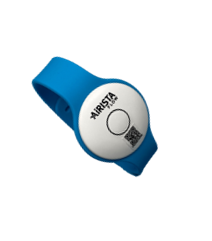
RTLS tags give clinicians real-time insight to the location of patients, wait times, occupancy levels and provide a historic path of the patients’ journey. When combined with other applications, hospitals can respond in real time to surges, equipment location, clinician availability, and downstream activity that might help mitigate constraints upstream.
 With AiRISTA’s Sofia™ platform, analytics can be applied to continuously surface trends in patient wait times, occupancy levels, and staff availability — providing the real-time operational data layer that other systems depend on. This foundation of continuous location intelligence is what enables the shift toward what industry analysts call the Real-Time Health System (RTHS): an operational model where healthcare organizations move from reactive problem-solving to proactive, data-driven capacity management.
Interactive Patient Tags That Improve Efficiency
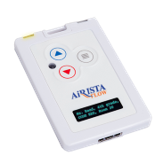
Because many RTLS patient tags have buttons, like the AiRISTA eTW2 wrist tag and A-series pendant tags, patients can generate notifications to indicate when they have arrived at a destination like the phlebotomy lab to have blood drawn. These automated interactions not only improve efficiency but reduce the number of opportunities for errors and streamline communication.
More sophisticated tags like the AiRISTA B4n tag have a text display to provide instructions to patients and clinicians. Sending an alert to the tag with text descriptions of their next stop provides mobility for patients, allowing them to avoid crowded waiting areas and make stops at the pharmacy, for example, to expedite their hospital visit.
Memorial Sloan Kettering Cancer Center, for example, gives a badge to a caregiver or family member who accompanies the patient so that staff can approach them without having to call out the patient’s name in a waiting area—protecting privacy while improving communication.
Making the Most of Your RTLS Investment Beyond Patient Flow
Once deployed, RTLS technology provides benefits complementary to patient flow. Daniel Stein, MS, PhD, of Memorial Sloan Kettering Cancer Center uses RTLS in other creative ways in his role as director of informatics and innovation:
- Automated alarm management: When an alarm sounds in a patient room, automatically turn it off when the responding clinician arrives wearing a tag
- Digital identification: When a clinician enters a patient room, the name and role of the clinician is displayed on a monitor in the patient’s room to help distinguish the many people attending to the patient
- Family communication: Update family members in the waiting area of the progress of their loved one through the operating process. Because the system knows when the patient moves from the OR to recovery, for example, the status is updated on a display automatically
- Equipment availability: Locating equipment like wheelchairs can expedite a patient’s discharge. Similarly, equipment requiring maintenance can be located, serviced and returned to the floor to increase equipment utilization
These extended use cases demonstrate how RTLS asset tracking solutions create value across multiple operational domains beyond patient flow management.
How to Get Started with Patient Flow Improvement
The Institute for Healthcare Improvement (IHI) created a whitepaper titled “Achieving Hospital-wide Patient Flow.” The IHI’s two-decade analysis of patient flow recommends a multifunctional team approach to patient flow improvement that takes a view of the hospital from end to end.
“The key to execution is to plan and deploy a hospital-wide patient flow strategy. No single initiative or set of unaligned projects is enough to produce system-level results.”
The white paper outlines four key execution strategies to improve patient flow:
1. Provide Oversight of System-Level Performance
For lasting change, the contributing teams need support and guidance from the executive staff to ensure cooperation across all of the affected departments.
2. Use Hospital-wide Flow Measures to Guide Learning and Improvement to Achieve Results
Create agreed-to metrics by which improvement is measured. This can include metrics like the percent of patient days with flow delays, or percentage of available capacity.
3. Create a System for Achieving Breakthrough Performance Improvement
Develop a portfolio of improvement measures, resource appropriately, and bring lessons learned back into the broader organization.
4. Build Quality Improvement Capability at All Levels of the Organization
Success depends on qualified and committed individuals at the various levels of the organization.
Choosing the Right RTLS Platform
To position technologies like RTLS at the center of your patient flow initiatives, consider vendors with an end-to-end solution that addresses a range of use cases. These platforms must aggregate insights from across the enterprise into a combined view of performance including all points of healthcare delivery in the hospital.
AiRISTA’s sofia platform is designed to support this comprehensive approach to patient flow management. The platform provides:
- Real-time visibility into patient location and status across the care journey
- Automated workflow triggers that respond to patient movement and status changes
- Integration capabilities that connect with existing hospital systems and care coordination platforms
- Analytics and reporting that identify bottlenecks and opportunities for improvement
- Scalable deployment options delivered on-premises or from the cloud
By providing continuous operational intelligence about where patients, staff, and equipment are at any given moment, RTLS creates the foundation for the kind of real-time coordination that modern patient flow management demands.
The Strategic Value of Patient Flow Optimization
With hospitals operating at or above 100% inpatient capacity, ED overcrowding reaching systemic levels, and national average revenue at $1,900–$2,200 per bed per day, every hour of boarding and every delayed discharge represents a quantifiable cost to the system.
The hospitals leading on flow performance are not doing so because they have more beds, more staff, or better payers. They are doing so because they shifted from reactive fire-fighting to proactive capacity management, adopted integrated visibility technology, and treated discharge planning as a flow tool rather than an administrative task.
RTLS technology is a critical enabler of this transformation. By providing the real-time operational data layer that other systems depend on, RTLS helps healthcare organizations move from visibility to action—and from patient flow challenges to patient flow excellence.
Ready to explore how RTLS can transform your patient flow management?
Contact AiRISTA at 844-816-7127 or salesinfo@airistaflow.com for a demonstration or consultation.
Discover how leading healthcare organizations are using real-time location intelligence to optimize patient flow, reduce boarding times, and improve outcomes across the care continuum.
Sources
- Chalfin D, Trzeciak S, Likourezos A, Baumann BM, Dellinger RP; DELAY-ED study group. Impact of delayed transfer of critically ill patients from the emergency department to the intensive care unit. Critical Care Medicine. 2007;35(6):1477-1483.
- Rutherford PA, Anderson A, Kotagal UR, Luther K, Provost LP, Ryckman FC, Taylor J. Achieving Hospital-wide Patient Flow (Second Edition). IHI White Paper. Boston, Massachusetts: Institute for Healthcare Improvement; 2020.
- Janke AT, Burke LG, Haimovich AD. Emergency Department Boarding and Outcomes: A Multi-Year Study of 46 Million Hospitalizations in the United States. Health Affairs. 2025.
- Emergency Nurses Association. Statistics on ED Boarding Times. August 2025.
- Joint Commission Resources on Patient Flow, or AHA 2025 Cost of Caring Report.
- Mordor Intelligence. Patient Flow Management Solutions Market Size and Forecast. 2024. (supports Change 2 market figure)
- Howlett N, Cameron J, Wood R. Medical patient boarding in the emergency department as a source of crowding and delay-related harm, impacting patient outcomes and the efficiency of urgent and emergency care. Emergency Medicine Journal. February 2026. (supports Change 3 new bullet)
- Brock PA, Langabeer DM, Page VD, Li Z, Qdaisat A. Impact of Boarding Time on In-Hospital Mortality in Patients Presenting to an Oncologic Emergency Department of a Comprehensive Cancer Center. ACEP Open. October 2025.
About The Author


