

A Structural Crisis That Has Not Resolved
The healthcare staffing crisis that accelerated during the pandemic has not been resolved. It has evolved into something more structural and harder to reverse. According to the 2025 NSI National Health Care Retention & RN Staffing Report, the average hospital RN turnover rate was 16.4% in 2024, and NCSBN’s 2024 National Nursing Workforce Study, which surveyed 800,000 nurses, found that more than 138,000 nurses have left the workforce since 2022, with nearly 40% of those remaining intending to leave by 2029.
The financial toll is direct and measurable. Replacing a single registered nurse costs hospitals an average of $61,110. U.S. hospitals spent approximately $1.7 billion on travel nurses in 2024 alone. Health Resources and Services Administration (HRSA) projects a shortfall of more than 78,000 full-time RNs in 2025, and the American Medical Association (AMA) reports that nearly 44% of the physician workforce is at or approaching retirement age. The AHA’s 2025 Workforce Scan noted that burnout and turnover dropped for the first time since the pandemic — an encouraging sign. But over 40% of hospitals still report RN vacancy rates above 10%, and the cycle of overwork driving attrition continues to threaten long-term workforce stability,

A 2026 survey of 103 healthcare executives by Becker’s Hospital Review identified workforce stability as the defining challenge of the year. Critically, several executives tied workplace safety directly to long-term talent sustainability, noting that if safety is not addressed proactively, healthcare will continue to lose dedicated professionals — and fewer will choose to enter the field at all.
Retention Is the Most Urgent Priority
The most urgent priority for health systems isn’t just recruitment — it is keeping the staff they already have. Staff who feel unsupported, unsafe, or burned out are the most likely to leave. Technology can’t replace human leadership and culture, but it can meaningfully reduce the frictions that drive burnout: wasted time, unsafe conditions, and lack of operational support.
That’s where Real-Time Location Systems (RTLS) come in. RTLS uses wireless tags, sensors, and software to track the real-time location of equipment, patients, and staff throughout a facility. When deployed thoughtfully, RTLS addresses several of the specific pain points pushing healthcare workers toward the exit.
How RTLS Addresses the Conditions That Drive Staff Away
Eliminating Time Lost to Equipment Searches
One of the most consistent frustrations nurses report is time lost searching for equipment. A 2024 study found that nurses spend up to one hour per shift searching for equipment, contributing to an estimated $14 billion in annual lost productivity across the U.S. healthcare system. That’s time taken directly away from patient care and from any sense of meaningful, manageable work.
RTLS asset tracking gives nurses instant visibility into the location of the nearest available wheelchair, IV pump, or ventilator through AiRISTA’s Sofia™ platform — accessible from any connected device on the floor. Staff no longer need to walk unit to unit or call other departments. The search time drops dramatically. When staff can do their jobs without hunting through hallways and supply closets, the daily burden of the role decreases in a way that compounds across every shift

Eliminate Time Lost Searching for Equipment
Give your staff instant visibility into the equipment they need with AiRISTA’s RTLS-powered asset tracking solutions. Reduce time spent searching, improve workflow efficiency, and return valuable time back to patient care.
Schedule a consultation: salesinfo@airista.com | 1-844-816-7127
Protecting Staff from Workplace Violence
Workplace violence has become one of the most significant drivers of healthcare worker attrition. According to a 2024 survey by National Nurses United, 81.6% of nurses experienced at least one type of workplace violence incident in the past year. A 2024 survey of emergency physicians found that 91% had either been a victim of violence or had a colleague who had been, and 71% said it was getting worse. The AHA estimates the total annual financial cost of violence to U.S. hospitals at $18.27 billion.
Beyond the financial toll, the psychological burden — burnout, PTSD, absenteeism — makes workplace violence a direct contributor to the staffing crisis. Healthcare executives surveyed by Becker’s in 2026 were explicit: safety must be treated as a workforce imperative, not a compliance issue.
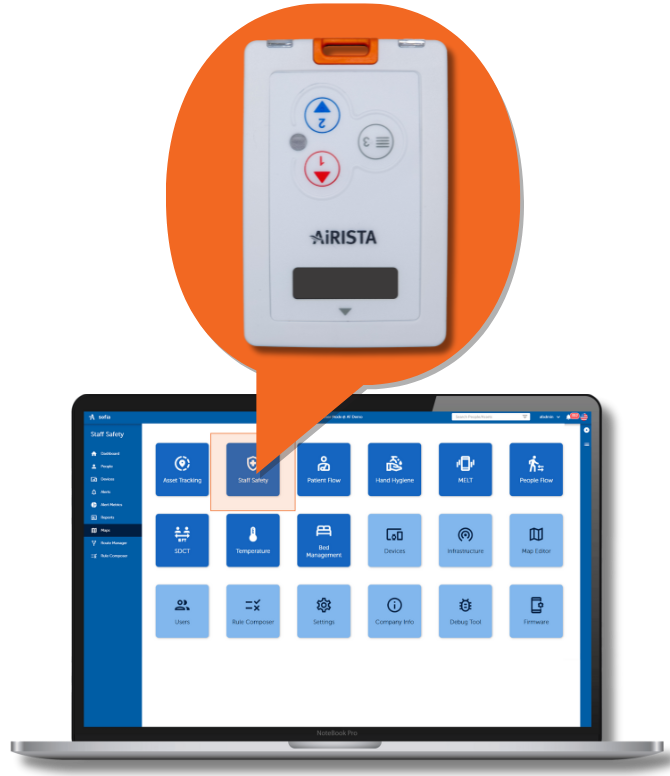
AiRISTA’s B4i and B6 staff badge tags address this directly. With a single discreet button press, a staff member under duress sends an immediate alert. Security personnel receive the staff member’s precise real-time location through the Sofia® platform, continuously updated as they move. Responders always know where the person is, not just the room where they first pressed the button.
When staff know that help is a button press away and that the system will locate them wherever they are in the facility, it changes the psychological experience of working in a high-risk environment. That sense of being supported is a retention factor that is difficult to quantify precisely and impossible to ignore.
Improving Patient Flow and Reducing Workload Pressure
Short-staffed units don’t just create individual burden; they create systemic bottlenecks. Patients waiting in hallways, delayed discharges, and beds tied up by patients ready to move all multiply the workload on every nurse present. RTLS helps by providing real-time visibility into patient location and bed status, enabling care teams to identify and resolve flow bottlenecks before they compound.
AiRISTA’s platform with Patient Flow Manager provides an intuitive view of patient movement, status, and location across the facility. The outcomes from hospitals using AiRISTA’s patient flow solution include a 70% efficiency improvement for porters through automated workflows, and a reduction in the time nurses spend supporting the portering function from 40 minutes to 5 minutes per patient transaction. When the administrative coordination burden on nurses drops that significantly, the time that returns to direct patient care is real and immediate.
RTLS-enabled badges can also automate routine tasks like nurse call cancellation. When a nurse enters a patient’s room, their badge automatically cancels the call and logs the arrival time, eliminating the need to navigate equipment to hit a button manually. These small workflow automations, multiplied across a shift and a facility, reduce the administrative friction that contributes to burnout in ways that individual interventions rarely capture.
Supporting Hand Hygiene Compliance
AiRISTA’s RTLS platform tracks when clinicians interact with hand sanitization stations and links those events to room entries or patient contact, producing compliance records that support both infection control and regulatory requirements. Improved hand hygiene compliance directly reduces the spread of hospital-acquired infections, protecting patients and reducing the additional clinical burden on staff that comes with managing preventable complications. The documentation is automated, removing yet another manual task from already stretched clinical teams.
Which RTLS Technologies Are Best for Healthcare?
RTLS technology has matured significantly. The right choice depends on the use case and required accuracy.
Bluetooth Low Energy (BLE)
BLE is now the dominant technology for the majority of healthcare RTLS applications. BLE tags are cost-effective, carry multi-year battery life, and can leverage existing Wi-Fi access points and BLE gateways. They are well-suited for asset tracking, hand hygiene compliance, patient flow, and proximity-based workflows. AiRISTA’s BLE tag family — including the e-Series asset tags and A-Series patient and staff badges — is designed specifically for hospital environments, with small form factors and waterproof casings that withstand clinical cleaning protocols.
Wi-Fi-based RTLS
Wi-Fi RTLS leverages a hospital’s existing wireless network to provide room-level or zone-level location accuracy. For organizations that have already invested in enterprise-grade Wi-Fi infrastructure, this offers a lower incremental cost path to facility-wide coverage. AiRISTA’s B4i and B6 staff safety badges operate on Wi-Fi — with the B6 adding dual-band support for 2.4 and 5 GHz networks — making them well-suited for staff duress applications where broad facility coverage and existing infrastructure alignment are both priorities.
Hybrid Deployments
Most enterprise healthcare RTLS deployments combine technologies to match the accuracy requirement of each use case. AiRISTA’s platform is built to support multi-technology environments — BLE for asset tracking and hand hygiene, Wi-Fi for staff safety coverage — so hospitals can expand capabilities without replacing the infrastructure already in place.
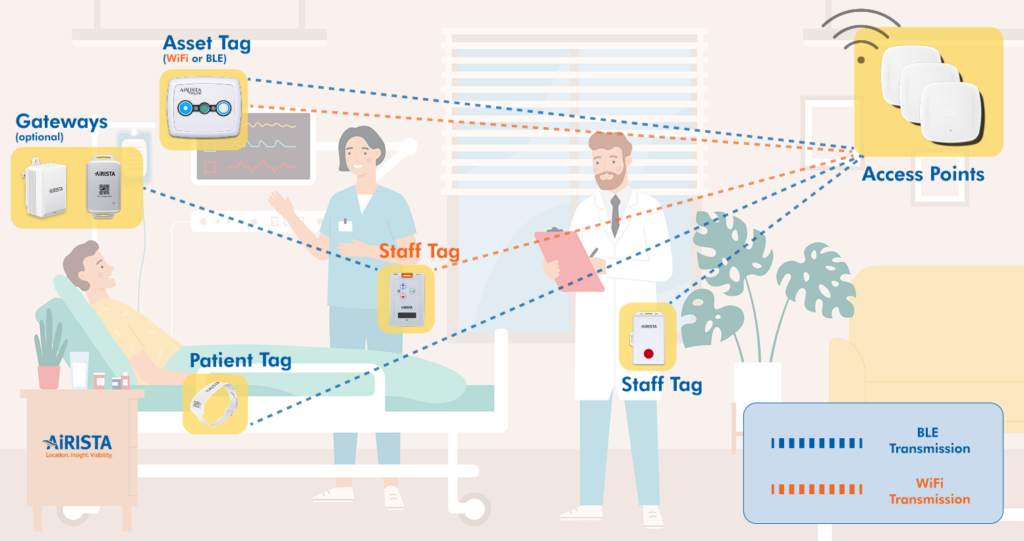
AiRISTA’s tags also support additional onboard sensors that relay temperature, humidity, and motion data, enabling environmental monitoring and condition-based alerting on the same platform. More advanced badge tags support two-way communication for coordinated team response during incidents.
The Staffing Crisis Requires Operational Answers
Healthcare staffing shortages are a multifaceted problem with no single solution. But the conditions that drive good staff to leave — unsafe environments, inefficient workflows, and the sense that leadership has not invested in their operational reality — are exactly the conditions RTLS is built to address.
The connection between operational support and retention is direct. Staff who spend less time searching for equipment, work in environments where help is a button press away, and are freed from administrative friction are more likely to stay. Safety investments have become foundational to workforce strategy, not because they are required, but because the cost of losing experienced staff has become impossible to absorb.
AiRISTA has more than 20 years of experience deploying RTLS solutions in some of the most demanding healthcare environments in the country — from high-acuity behavioral health facilities to large multi-campus hospital systems. The Sofia™ platform supports staff safety, asset tracking, patient flow, and hand hygiene compliance on a single integrated infrastructure, layering onto existing Wi-Fi and EHR investments rather than replacing them. The low-code/no-code configuration environment means new workflows and capabilities can be deployed without intensive IT overhead.
If your organization is looking for ways to retain the staff you have and make their working environment safer and more efficient, contact us to discuss your specific challenges: salesinfo@airistaflow.com
Sources:
NSI National Health Care Retention & RN Staffing Report (2025); NCSBN 2024 National Nursing Workforce Study; HRSA Nursing Workforce Projections; American Medical Association 2024 Workforce Report; AHA 2025 Workforce Scan; Becker’s Hospital Review, 10 Healthcare Workforce Challenges Defining 2026 (2026); Vizzia Technologies and Georgia State University, HIMSS-published research on nursing equipment search time (2024); National Nurses United 2024 Workplace Violence Survey; American Hospital Association — The Burden of Violence to U.S. Hospitals (2025); AiRISTA, California Department of State Hospitals Staff Safety Deployment; AiRISTA, Patient Flow Solution Outcomes Data; NSI Nursing Solutions, 2025 National Health Care Retention Report (RN turnover cost data).
About The Author


