

Real-time location systems have moved well past the early-adopter phase. RTLS is now considered mature, expected operational infrastructure across healthcare, industrial, and logistics environments — and it is still growing at a rate that surprises people who assume maturing technology means slowing investment.
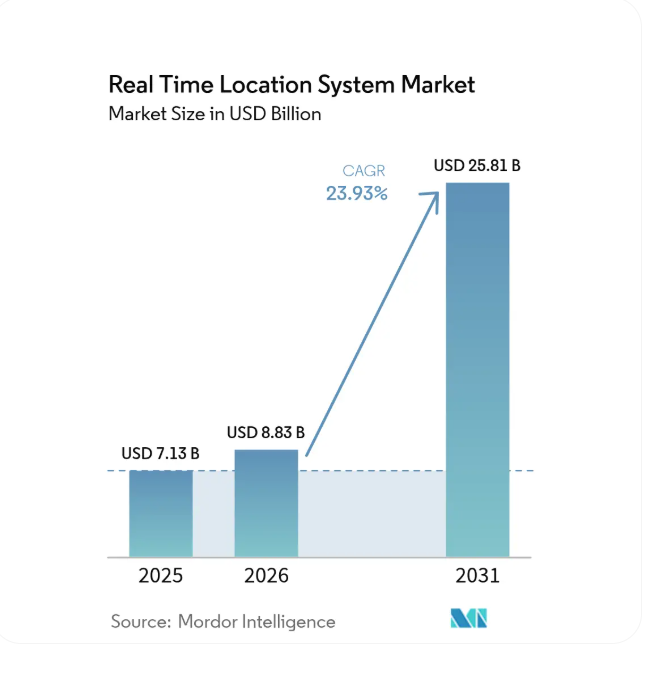
The market data is unambiguous. According to Mordor Intelligence’s January 2026 report, the global RTLS market is estimated at $8.85 billion in 2026 and is projected to reach $25.85 billion by 2031, growing at a 23.91% compound annual rate. In healthcare specifically, the market is expected to expand from roughly $3.2 billion in 2026 to more than $11 billion by 2034. And the composition of that growth is shifting: the services segment — ongoing software, integration, and platform expansion — is now growing faster than hardware, a signal that organizations are no longer just buying RTLS for the first time. They are building on it.
What is driving a technology this far along the maturity curve to keep compounding at double-digit rates? Five forces explain the acceleration — and together they signal that RTLS is becoming a fundamentally different kind of investment than it was five years ago.
1. Regulatory and Compliance Pressure Around Staff Safety
Staff safety has become one of the most significant and fastest-growing drivers of RTLS purchasing — in its own right, not just as a feature bundled into a broader deployment. The 2026 Joint Commission workplace violence prevention standards are now in effect, requiring accredited hospitals to assess risk, implement prevention programs, and demonstrate measurable outcomes.
The financial stakes make the regulatory pressure concrete. Workplace violence costs U.S. hospitals an estimated $18.27 billion annually according to the AHA’s 2025 analysis. Personnel locating and monitoring has become the fastest-growing RTLS application segment as a direct result (Precedence Research, 2026). Healthcare workers experiencing violence are twice as likely to leave the profession — a retention consequence that connects staff safety directly to the workforce crisis already straining most health systems.
AiRISTA’s staff badge tags are deployed for staff safety and duress alerting across some of the most demanding clinical environments in the country, including the California Department of State Hospitals — spanning five facilities with more than 13,000 employees — where the deployment was completed on existing Wi-Fi infrastructure in seven days per facility following legislative action on workplace violence.
For organizations that have not yet deployed a documented, technology-supported staff safety program, the window for proactive investment is narrowing. Regulatory requirements are expanding, and the organizations building this infrastructure now will have the compliance documentation, incident data, and staff confidence that those scrambling to respond later will not.
2. Falling Hardware Costs and Widening Addressable Market
RTLS hardware has followed the consumerization cost curve seen across most connected hardware categories, and the impact on market access has been significant. A basic BLE tag now costs a few dollars at volume. Lower price ranges have opened RTLS to a much wider set of budgets and use cases than existed five years ago.
New vendors continue entering the market with RTLS capability embedded directly into everyday clinical and operational devices, expanding the addressable market well past its original footprint in large academic health systems and tier-one manufacturers.
The cost decline has also changed the scope of conversation. Organizations that previously piloted RTLS in a single department can now justify enterprise-wide tagging of entire asset fleets. The economics of tracking lower-value items — beds, wheelchairs, carts, portable monitors — that were previously impractical have shifted enough to make comprehensive tagging feasible. The question has moved from whether RTLS is affordable to which use cases to deploy first.

Build For What Comes Next
Talk with AiRISTA about evaluating your current environment, RTLS readiness, and infrastructure strategy before deployment decisions are finalized.
3. BLE as the Enabling Technology Layer
Bluetooth Low Energy has become the technology most responsible for making RTLS accessible at healthcare and industrial scale — and its continued evolution is expanding what that accessibility enables. BLE balances infrastructure cost, tag battery life, deployment flexibility, and reliable location accuracy.
The practical foundation for this is significant: most enterprise wireless access points from Cisco, HPE, Arista, and others now include BLE. For organizations that have already invested in enterprise-grade wireless infrastructure, BLE RTLS can often be deployed by augmenting — rather than replacing — that existing network. BLE currently holds the largest share of hospital asset tracking deployments at roughly 34% (Future Market Insights, 2026).
The implication for organizations evaluating RTLS infrastructure is that BLE investment made today is durable, not transitional. A hospital that deploys BLE for asset tracking finds that the same infrastructure, with the addition of staff badges, supports a duress response program. Add patient tags, and it supports flow visibility. AiRISTA’s Sofia™ platform is built to support this progression.
4. RTLS Maturing Into Shared Operational Infrastructure
Perhaps the most consequential structural shift in the RTLS market over the past several years is a change in how organizations think about what they are buying. Organizations that initially deployed RTLS as a point solution — to solve one problem in one department — are discovering that the location data layer they built is valuable across a much wider range of operational workflows than the original use case justified.
A hospital that deployed RTLS for asset tracking finds that the same infrastructure, with the addition of staff badges, supports a duress response program. The same platform, with patient tags, supports flow visibility and discharge automation. The same location data, integrated with the EHR and nurse call system, automates workflows that reduce administrative burden on clinical staff. Each additional use case adds operational value on infrastructure already in place — which fundamentally changes the ROI math and the procurement conversation.
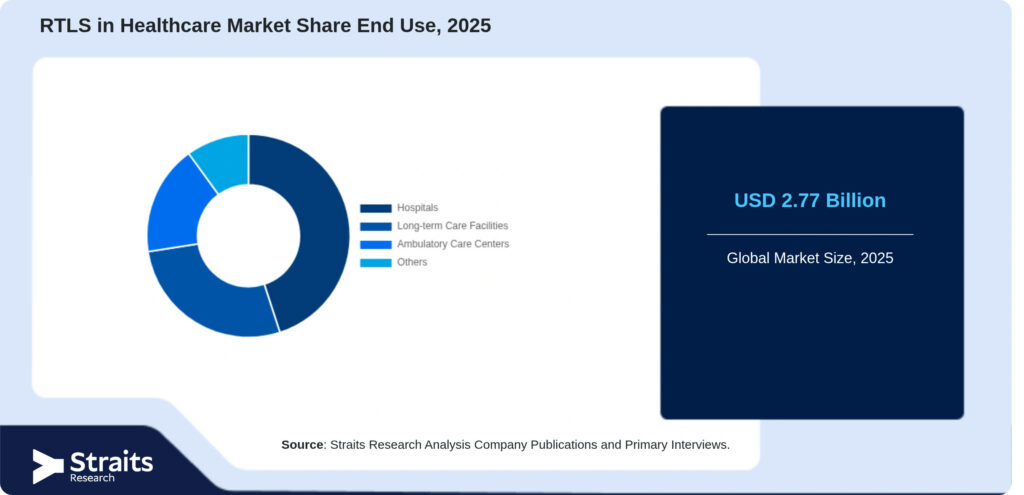
This pattern is what analysts observe when they note that services spending is now growing faster than hardware in the RTLS market. Organizations are not buying new infrastructure for each new use case. They are expanding capabilities on a platform they already own. That dynamic converts one-time deployment customers into long-term platform customers, and it creates a sustained growth engine that does not depend on new organizations entering the market — though they are doing that too.
5. Demonstrated ROI Across a Growing Deployed Base
RTLS adoption has reached the stage where the business case no longer depends primarily on projected benefits. A large and growing body of documented operational outcomes makes the case more concretely than market projections alone — and that evidence base is what accelerates adoption among organizations that have been watching peers deploy and produce results.
In healthcare: nurses spend up to 60 minutes per shift searching for medical equipment, contributing to an estimated $14 billion in annual lost productivity (HIMSS-published research, 2024). Hospitals using AiRISTA’s patient flow and asset tracking platform have documented a 70% improvement in porter efficiency through automated workflows, a reduction in nurse time spent coordinating transport from 40 minutes to 5 minutes per transaction, and fleet right-sizing that generated savings exceeding $1 million at a single 380-bed facility — deployed in 21 days on existing wireless infrastructure.
In manufacturing and logistics: RTLS is increasingly used not just to locate tools and work-in-progress, but to understand how labor is actually applied on the floor as workforce shortages put pressure on every shift. The ability to generate objective, timestamped data about where workers and assets are provides a foundation for process improvement that replaces estimation with evidence.
What These Five Forces Mean for Organizations Evaluating RTLS Now
Taken together, these forces explain why RTLS growth is not a lagging indicator of a technology past its peak. It is a leading indicator of a technology becoming foundational operational infrastructure — one that organizations build on over time rather than replace. The organizations that recognized that early are now expanding use cases on infrastructure they already own. The organizations still evaluating are making that decision against a backdrop of regulatory pressure, demonstrated peer outcomes, and a cost environment that has removed most of the historical barriers to entry.
AiRISTA’s Sofia™ platform supports that progression — from initial asset tracking through staff safety, patient flow, and workflow automation — on existing wireless infrastructure, without requiring organizations to rebuild the foundation as their use cases evolve. Contact AiRISTA to discuss your RTLS roadmap.
Sources
Mordor Intelligence, Real Time Location System Market Report (January 2026); Straits Research, Global RTLS in Healthcare Market Size & Outlook 2026–2034 (2026); Precedence Research, RTLS Healthcare Market Size to Surpass USD 18.28 Bn by 2035 (January 2026); Future Market Insights, High-Value Healthcare Asset Tracking and Recovery Platforms Market (April 2026); IndexBox, Real Time Location System RTLS Healthcare Market Growth Outlook to 2035 (May 2026); Arensic International, RTLS for Healthcare Market Size, Share & Industry Analysis, 2026–2032; Joint Commission, Workplace Violence Prevention Standards (2022, updated 2026); American Hospital Association, The Burden of Violence to U.S. Hospitals (2025); Vizzia Technologies and Georgia State University, HIMSS-published research on nursing equipment search time (2024); AiRISTA, Patient Flow and Asset Tracking Solution Outcomes Data.
About The Author


