

The typical hospital manages more than 35,000 inventory SKUs. Yet despite that enormous investment in equipment, asset utilization rates hover between 32% and 42% depending on the facility and equipment type. Hospitals routinely purchase or rent 20% to 30% more medical devices than they actually need — not because the equipment does not exist, but because they cannot find it when they need it. As Peter Drucker observed, “you can’t manage what you can’t measure,” and for most hospitals, mobile asset management has historically been a guessing game.
Real-Time Location Systems — RTLS — are changing that. The global RTLS in healthcare market was valued at $2.46 billion in 2024 and is projected to reach nearly $10 billion by 2033, growing at roughly 17% annually. Hospital asset tracking is the single largest application driving that growth. Here are the six most impactful ways healthcare organizations are putting it to work.
1. Locate the Nearest Available Equipment in Real Time
The most common and immediately valuable use of an asset tracking solution is locating the nearest available piece of equipment in real time. The cost of not having this capability is significant and well-documented. A 2024 peer-reviewed study published by HIMSS found that nurses spend up to 60 minutes per shift searching for medical equipment, and the resulting lost productivity costs U.S. hospitals an estimated $14 billion annually — time taken directly from patient care.
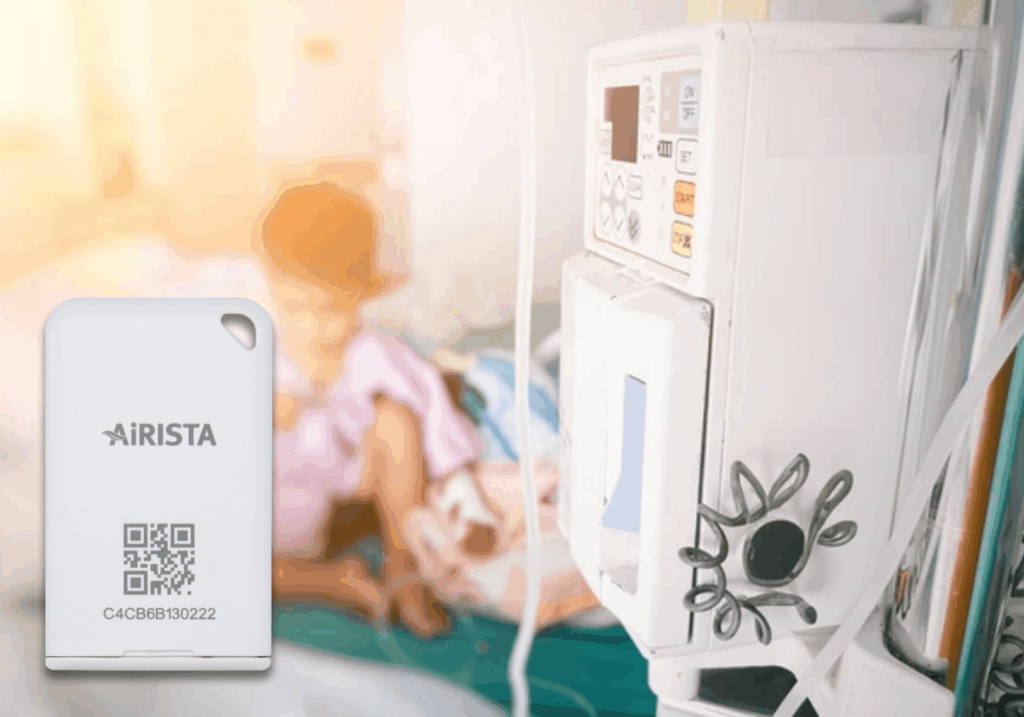
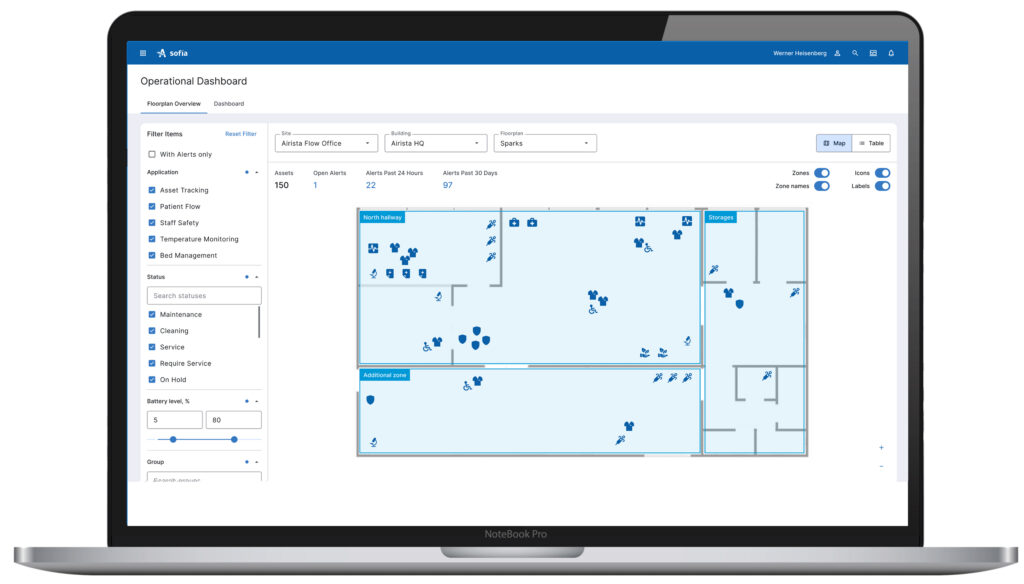
With RTLS asset tracking, a nurse can identify the nearest clean, available wheelchair, IV pump, or ventilator in seconds from any device connected to the platform. The search eliminates the need to walk unit to unit or call other departments. AiRISTA’s Sofia™ platform surfaces this information through intuitive dashboards with direct access to maps and equipment status, using existing Wi-Fi infrastructure so the solution integrates without requiring new network build-out.
The downstream benefits extend beyond the search itself. Staff burnout and turnover remain among the costliest operational challenges facing hospitals today. Removing the friction of equipment hunts has measurable retention value — staff who spend less time chasing equipment spend more time on the work they are trained to do.
2. Automate Par Level Management
Par levels allow clinical and operational teams to set minimum and maximum inventory thresholds for a range of equipment across designated zones or units. When a unit drops below its minimum wheelchair count, for example, the system triggers an alert. When it exceeds its maximum, it flags a potential hoarding situation where equipment from another unit has migrated and is sitting unused.
AiRISTA’s Sofia® platform enables teams to draw geographic zone boundaries directly on a facility floor plan and assign PAR thresholds to each zone. Alerts are delivered through the channels staff already use — email, SMS, or integration with existing nurse call systems — so no one needs to log into a separate platform to act on them. This is what makes PAR management practical at enterprise scale: it transforms inventory management from a periodic manual count into a continuous, automated process.
Hospitals that purchase or rent excess equipment to compensate for poor visibility are spending money that PAR-level management can recover. With accurate real-time counts by zone, procurement decisions become data-driven rather than reactive. The inventory overstock disappears when staff can trust the system to surface shortfalls before they become a problem.
3. Measure and Improve Asset Utilization
Low utilization is one of the most underappreciated cost drivers in hospital operations. Research consistently shows that between 10% and 20% of a hospital’s mobile assets are lost or stolen over their useful life at an average cost of $3,000 per item. Beyond outright loss, equipment that exists somewhere in the facility but cannot be found effectively has a utilization rate of zero.
Measuring utilization accurately requires more than knowing where equipment is. An effective RTLS platform supports multiple methods of defining “use” depending on the asset: zone-based utilization (is this pump in a patient room?), motion-based utilization (has this device moved in the past 12 hours?), and utilization derived from integration with third-party clinical applications such as infusion management systems.
AiRISTA deployed its RTLS asset tracking solution at a 380-bed regional medical center struggling with an IV pump utilization rate of 30% across a fleet of 1,200 devices. After deployment — completed in 21 days on the facility’s existing Wi-Fi infrastructure — utilization increased to 65%. The most recent IV pump purchase was reduced from 1,200 to 780 devices, a fleet right-sizing that generated savings exceeding $1 million. Download the Asset Tracking Solution Brief.
When a hospital can see that 40% of its infusion pumps are sitting idle in a storage room while nurses on another floor are searching for one, the reallocation opportunity is immediate and obvious. Over time, this data informs smarter capital planning, reducing the tendency to over-purchase as a buffer against poor visibility — a pattern that costs hospitals millions annually across their device fleets.

Improve Asset Visibility with Real-Time Tracking
Gain full visibility into your critical equipment with AiRISTA’s RTLS-powered healthcare asset tracking solutions. Track, manage, and optimize asset utilization in real time to reduce loss, improve efficiency, and support better patient care.
Schedule a consultation: salesinfo@airista.com | 1-844-816-7127
4. Maintain Accurate Enterprise-Wide Inventory
For a CNO, CIO, or COO, getting an accurate, real-time count of assets across an entire health system is genuinely difficult. Most inventory data lives in departmental silos, updated manually and intermittently. The result is that enterprise-wide visibility requires stitching together incomplete records from multiple systems — a process that is slow, error-prone, and rarely current.
AiRISTA’s Sofia™ platform provides an instant, accurate count of every tagged asset by class, assigned unit, and current location. This is valuable for day-to-day operations, but it becomes critical in two specific scenarios.
The first is product recalls. When a manufacturer issues a recall on a specific model of infusion pump, a hospital with RTLS can identify and locate every affected unit within minutes. Without it, the process can take days of manual searching across units and floors.
The second is regulatory compliance. Accreditation bodies and risk management teams increasingly expect documented visibility into medical equipment. RTLS-generated inventory records provide an auditable, timestamped account of where equipment has been and when, supporting compliance with Joint Commission standards and other regulatory requirements without additional manual documentation burden.
5. Analyze Historic Movement Patterns
Every RTLS tag can be configured to emit location signals at a set interval. Each signal is detected by the wireless infrastructure, timestamped, and logged. Over time, these data points create a continuous movement trail of everywhere a tagged asset has traveled through the facility — a trail that can be replayed visually across any time window through the Sofia™ platform.

Historic pathing has several practical applications. For asset management, it reveals patterns of equipment migration across units, identifies chronic hoarding behavior, and helps operations teams understand where equipment naturally concentrates so they can position inventory more strategically. For infection control, it supports contact tracing by identifying which patients or staff members shared a space within a given timeframe. For staffing and workflow analysis, it provides an objective picture of how staff time is actually distributed across locations— data that can inform more accurate staffing models and operational improvement discussions without requiring time-consuming observation studies.
The same location trail that shows where an IV pump traveled also shows where a nurse spent their shift. Handled appropriately, that data surfaces meaningful workflow insights that would otherwise be invisible without it.
6. Deter Theft and Recover Lost Equipment
Hospital equipment theft is a genuine and underreported problem. Equipment can be sold on secondary markets, and in many cases hospitals do not discover the loss for weeks or months. Research on RTLS for loss prevention points to a Hawthorne effect: when staff know that all equipment is tracked and its location is logged continuously, the incidence of unauthorized removal drops.
Beyond deterrence, RTLS enables rapid response. Alerts can be configured to trigger when a tagged asset approaches an exit point or leaves a designated zone, giving security personnel time to respond before equipment leaves the building. In AiRISTA’s Sofia® platform, these zone-based alerts can be integrated with existing building security systems, directing cameras toward the relevant exit for immediate visual confirmation. Tamper-evident tags that alert when removed from an asset add another layer of protection for high-value devices.
RTLS also supports recovery of equipment that leaves the facility unintentionally — a more frequent occurrence than outright theft. A patient who leaves with a sequential compression device, equipment that travels with a patient transfer and is not returned, or a device lost in the laundry cycle can all be identified and recovered when every movement is tracked and timestamped.
The Platform That Connects All Six
Each of these six applications delivers value individually. The compounding effect comes when they share a common platform and a common data layer. AiRISTA’s RTLS software platform supports all six on a single infrastructure — meaning a hospital that starts with equipment location can layer in PAR-level management, utilization analytics, historic pathing, and theft deterrence without replacing its underlying investment.
Sofia™ integrates with EHR systems, CMMS platforms, nurse call, and building security. It supports BLE, Wi-Fi, and RFID hardware depending on the accuracy requirements of each use case, and leverages existing wireless infrastructure where it is available to minimize deployment complexity. The platform is delivered on-premises or from the cloud, with a workflow engine flexible enough to be customized to the specific operational requirements of each facility.
The 380-bed regional medical center case, previously described, illustrates what the full platform delivers when deployed correctly: a utilization rate that doubled, a fleet right-sized by 35%, and more than $1 million in capital savings — on infrastructure already in place. That is not a theoretical ROI. It is the operational outcome that proper hospital asset tracking makes possible.
To learn how AiRISTA can help your organization move from reactive asset management to real-time operational visibility, contact us at salesinfo@airistaflow.com or visit our asset tracking solution page.
Sources
Grand View Research, RTLS in Healthcare Market Report (2024); Vizzia Technologies and Georgia State University, HIMSS-published research on nursing equipment search time (2024); Asimily, Accurate Utilization Data Improves Hospital Revenue (2024); Navigine, Healthcare RTLS Guide (2026); Cognosos, Hospital Asset Tracking and Loss Prevention (2024); TRL Systems, Financial Impacts of RTLS for Healthcare Organizations (2024); AiRISTA, IV Pump Utilization Case Study — 380-bed Regional Medical Center; The Joint Commission Standards for Medical Equipment Management.
About The Author


