

AiRISTA + Clinaris Integration: Solving Healthcare’s Missing Link Between Location and the Status of Medical Devices
How combining real-time location tracking and hygiene and process management improves infection control and operational efficiency.
Knowing where medical devices such as patient beds or ultrasound devices are located solves half the problem. Knowing whether these devices are clean, in use, contaminated, or defective solves the other half.
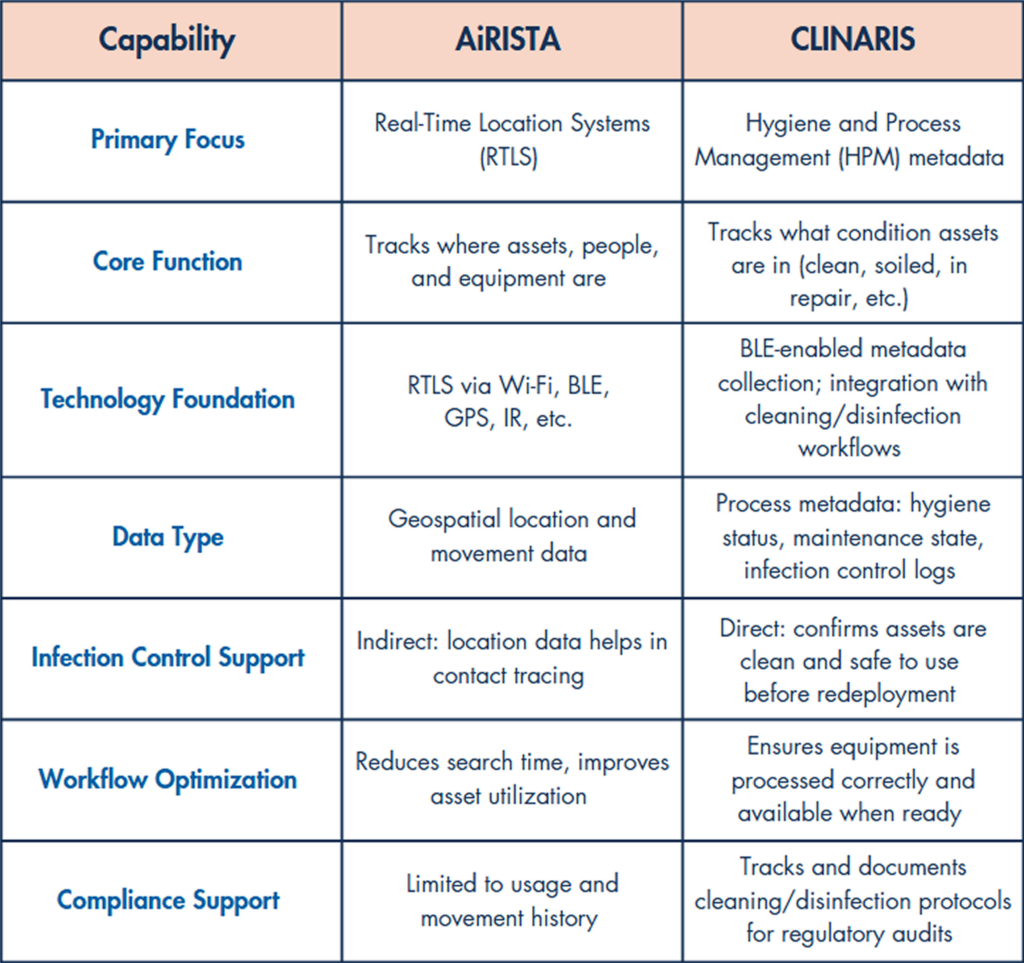
For years, healthcare organizations have deployed systems that answer one question or the other—but rarely both. Real-time location systems (RTLS) tell you where assets are. Hygiene and process management systems tell you what status they’re in.
The problem? These systems have operated independently, creating blind spots that impact infection control, operational efficiency and safety of patients, visitors and staff.
Today, we’re announcing the integration of AiRISTA’s Sofia RTLS platform with HPM® by CLINARIS, a hygiene and process management system, eliminating that blind spot and establishing a new standard for healthcare asset intelligence.
The Problem: Location Without Context
Imagine this scenario: A nurse needs an IV pump for a new patient. She checks the RTLS dashboard and sees three IV pumps on her floor. Perfect—she grabs the closest one.
But here’s what she doesn’t know:
- Pump #1 was just removed from an isolation room and hasn’t been disinfected
- Pump #2 completed cleaning but failed electrical safety testing
- Pump #3 has been properly cleaned, tested, and is ready for patient use
Without hygiene and technical status integrated with location data, the nurse has a one-in-three chance of selecting the right pump—and a far greater risk of introducing infection or using defective medical devices. This isn’t hypothetical. It happens daily in hospitals worldwide.
The Solution: Comprehensive Asset Intelligence
The AiRISTA + HPM® by CLINARIS integration solves this by combining AiRISTA’s sofia™ software for real-time location of medical devices and equipment with CLINARIS’ HPM® for their HPM® hygiene and technical status. Here’s how the integration works:
AiRISTA sofia™ RTLS
- Tracks the real-time location of medical devices across the healthcare facility
- Provides location intelligence using technologies such as BLE, Wi-Fi, RFID, and UWB
- Enables staff to instantly locate medical devices when it’s needed
CLINARIS HPM® Hygiene and Process Management
- Tracks cleaning, disinfection, and reprocessing workflows
- Documents hygiene compliance and maintenance processes
- Confirms when devices are ready for safe clinical use (i.e. free of defects and serviced / tested according to requirements)
Together, the systems provide a single view of both location and device status, giving healthcare teams the full context they need to make safe decisions.
Real-World Use Cases
Use Case #1: Optimizing Device Turnover
Without Integration:
- Devices cleaned, but location unknown
- Staff waste time searching for clean devices
- Clean devices remain unused while staff request rentals
With Integration:
- Device completes cleaning (HPM® confirms)
- Sofia shows the exact location
- Dashboard displays “clean device ready for use in Room 312”
- Staff retrieve immediately, no search time
- Utilization improves, rental costs decrease
Use Case #2: Maintenance Compliance
Without Integration:
- Devices due for preventive and predictive maintenance
- Location unknown, medical device can’t be serviced
- Compliance deadlines missed
With Integration:
- Compliance documentation automated
- HPM® labels devices which need maintenance
- Sofia provides the current location
- Work order automatically includes location data
- Biomedical team retrieves and services devices efficiently
The Benefits: Measurable Impact
By combining real-time location intelligence with hygiene and process management, the AiRISTA + HPM® by CLINARIS integration delivers measurable improvements across hospital operations.
Stronger Infection Control
- Prevent the use of contaminated medical devices and helps to break infection chains
- Real-time visibility into cleaning and hygiene compliance
- Automated documentation of disinfection protocols
Improved Operational Efficiency
- Eliminate time spent searching for clean, available devices
- Increase asset utilization by identifying equipment ready for use
- Reduce unnecessary equipment rentals and delays
Simplified Compliance
- Automated audit trails for regulatory reviews
- Documented proof of cleaning and maintenance workflows
- Reduced manual reporting and documentation
Enhanced Safety for Patients, Visitors and Staff
- Ensure only properly sanitized devices are used in patient care
- Prevent the use of defective or unmaintained devices
- Reduce cross-contamination risk across departments
Why This Integration Matters in 2026
Healthcare-associated infections (HAIs) remain a persistent challenge in hospitals. According to the CDC, 1 in 31 hospital patients has at least one HAI on any given day, contributing to an estimated 99,000 deaths annually in the United States and $28–45 billion in direct healthcare costs.
Device-related infections are preventable—but prevention requires knowing both where devices are and what condition they are in.
As infection control standards intensify and regulatory scrutiny increases, integrated systems that provide comprehensive asset intelligence move from “nice to have” to “essential infrastructure.”
Looking Ahead: The Future of Asset Intelligence
Healthcare operations are moving toward connected intelligence platforms rather than isolated systems. By combining location data with operational workflows, hospitals can unlock new capabilities such as:
- Predictive equipment maintenance based on usage patterns
- Automated redistribution of equipment to high-demand areas
- Real-time infection prevention monitoring
- Traceability of contaminated medical devices (even retrospective after patient discharge) helps to cut the chain of infection
- Digital twin models of hospital operations
The AiRISTA + HPM® by CLINARIS integration is an important step toward this more connected healthcare infrastructure.
Conclusion
Healthcare device management ultimately comes down to two questions:
- Where is it?
- Is it safe to use (no contaminations, no defects)?
For too long, hospitals have relied on systems that answer only one of those questions.
The AiRISTA + HPM® by CLINARIS integration brings both answers together—delivering the asset intelligence healthcare teams need to improve infection control, optimize operations, and protect patients.

Getting Started
Interested in how AiRISTA and CLINARIS can improve device visibility,
infection control, and operational efficiency in your facility?
Schedule a consultation: salesinfo@airista.com | 1-844-816-7127


